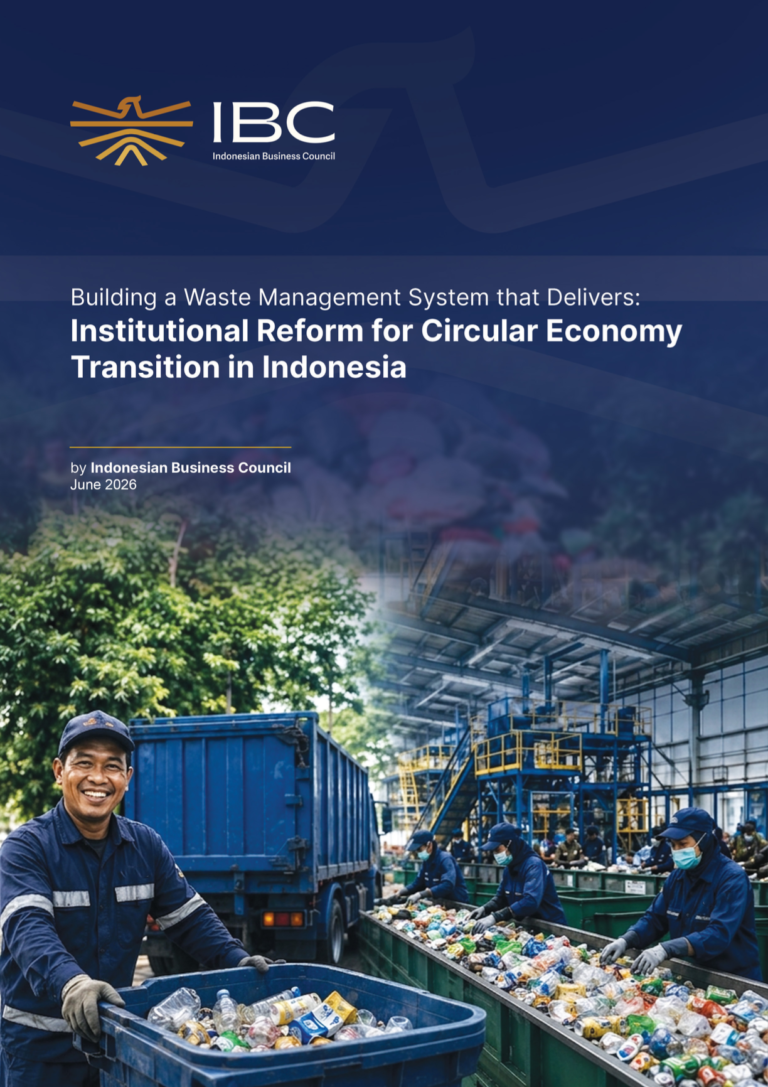
Indonesia’s cities and regencies face a waste management emergency due to persistent institutional weaknesses, ineffective household waste service delivery models, and weak policy implementation. As a result, Indonesia risks forgoing up to IDR 638 trillion in economic value from the transition to a circular economy.
This white paper by the Indonesian Business Council (IBC) presents ten policy recommendations to strengthen Indonesia’s waste management system through improved institutional arrangements, more effective service delivery models tailored to different city and regency contexts, and stronger regulatory coherence and policy implementation. Among the recommendations are separating the roles of regulator and operator through dedicated waste institutions such as BLUDs, BUMDs, or private partnerships; redesigning household waste collection models and integrating waste fees with existing utility billing systems; strengthening regulatory coherence through performance-based fiscal incentives, technical support, and capacity building for local governments; and rebuilding public trust through transparent service standards and effective communication. Together, these recommendations aim to create a waste management system where waste flows and financial flows reinforce one another, enabling greater private sector participation, stronger local government capacity, and a more sustainable circular economy.